How Loxtep Rolls Out in a Company
Bolting a chatbot onto a pile of tools does not make a company AI-native. The model can only see what you give it, and most companies give it fragments: a CRM here, a project board there, a spreadsheet nobody owns. Loxtep is the governed context plane those tools never shared. You still run Shopify, QuickBooks, and email. Loxtep makes them intelligible—to people and to agents—through Connect → Products ↔ Meaning → Use.
The sequence is the whole rollout. Skip a step and you automate fiction.
Connect
Point Loxtep at the tools you already run. Do not start by designing an agent. Start by mapping how work actually moves.
Map recurring work, then sample it
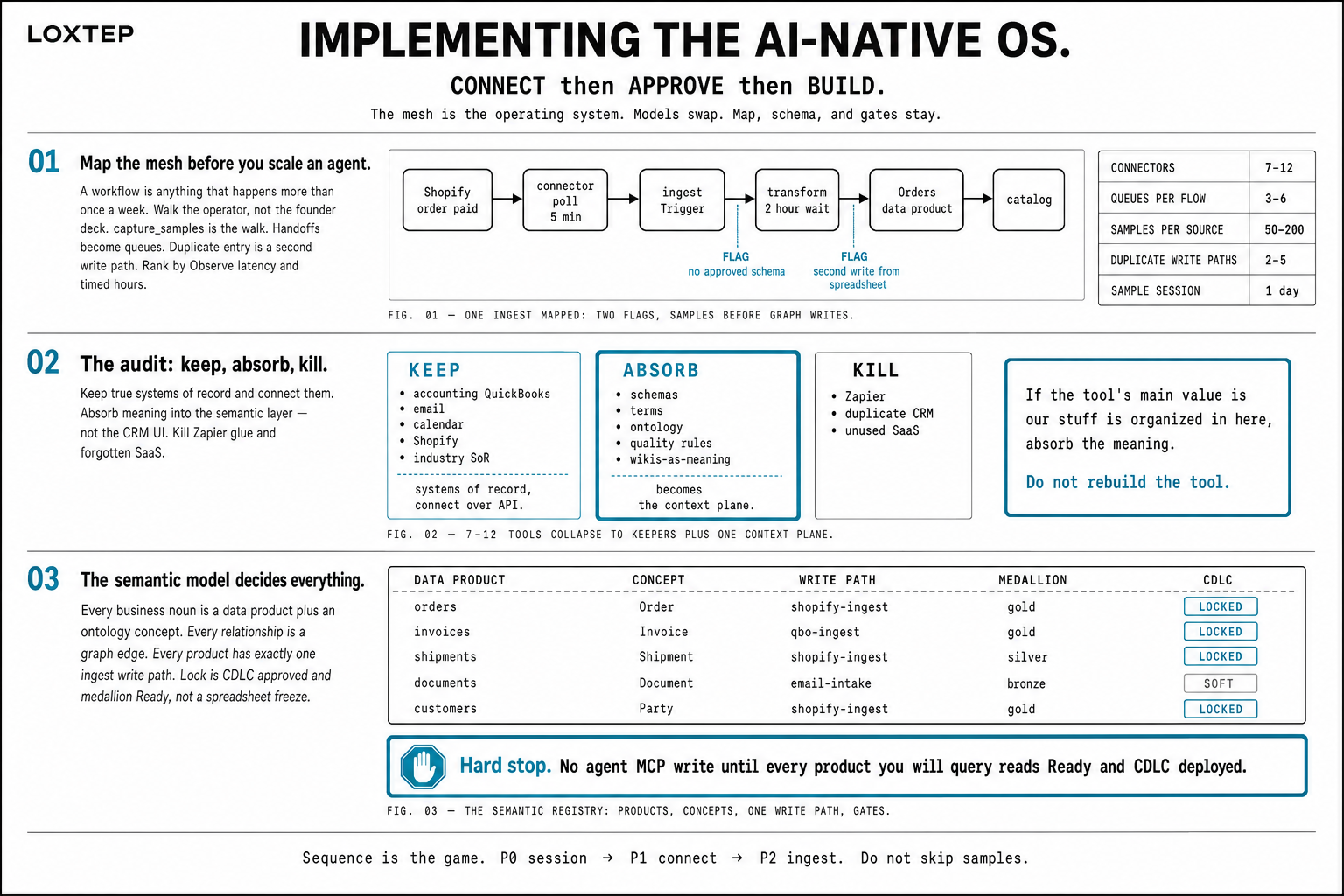
Anything that happens more than once a week is a workflow. Walk it with the person who runs it, not the slide the founder uses in all-hands. Write down the trigger, every handoff, what “done” looks like, and where the same fact gets typed twice.
In Loxtep that walk is not a workshop artifact. It is capture samples on a real connector, then an ingest workflow whose queues are the handoffs. Duplicate entry shows up as a second write path. Latency shows up in Observe. Rank what to connect first by timed manual hours and by those signals — whichever hurts more.
A typical first pass lands 7–12 connectors, a handful of queues per flow, and 50–200 sample records per source. One mapped ingest is enough to see the pattern: source event → Trigger → transform → data product → catalog. Flags on that path (no samples yet, a spreadsheet still writing the same entity) are the backlog. Do not write the rest of the graph until samples exist. See Connecting your Data and Build Your First Data Product.
Keep systems of record. Absorb meaning. Kill glue.
Sort every tool in the stack:
- Keep — true systems of record. Accounting, commerce, email, calendar, anything with regulatory weight. Authenticate them as connectors. They stay the write authority for their nouns.
- Absorb — meaning. Schemas, terms, ontology concepts, quality rules, the wiki that was really a glossary. That becomes the semantic layer, not a second CRM.
- Kill — unused seats, duplicate trackers, and glue that retypes the same row into two places. Loxtep workflows replace that glue.
Loxtep is not the system of record. If a tool’s only job was “our stuff is organized in here,” absorb the meaning and leave the tool or retire it on purpose. Do not rebuild Monday inside Loxtep.
Products and Meaning
Once data is flowing, Products and Meaning become a feedback loop. Products are the governed outputs you ready for wider use. Meaning is the reusable vocabulary, shapes, ontology, and process knowledge applied to them. Loxtep drafts definitions, relationships, and quality rules; humans lock consequential changes.
Meaning does not require a product. You can establish shared vocabulary and shapes first, then apply them to products as sources arrive. Product readiness never owns or silently rewrites shared meaning.
The semantic model decides what agents may see
Every business noun becomes a source or consumer data product plus an ontology concept. Every relationship becomes a graph edge. Every product gets exactly one ingest write path. Two writers for orders is how you spend a year reconciling “which total is real.”
Lock is not a spreadsheet freeze. Lock is context artifacts Approved → Published and data product readiness Ready on every product an agent will query. Raw is unenriched ingest. In Progress is locally semantic. Ready is the cross-domain contract. Version the schema when meaning changes. Record a decision trace when someone resolves an approval.
Hard stop: no agent write through MCP until the products in that question read Ready and deployed. The inbox (list_pending / resolve) is the gate. Mining candidates never auto-commit.
One domain in motion
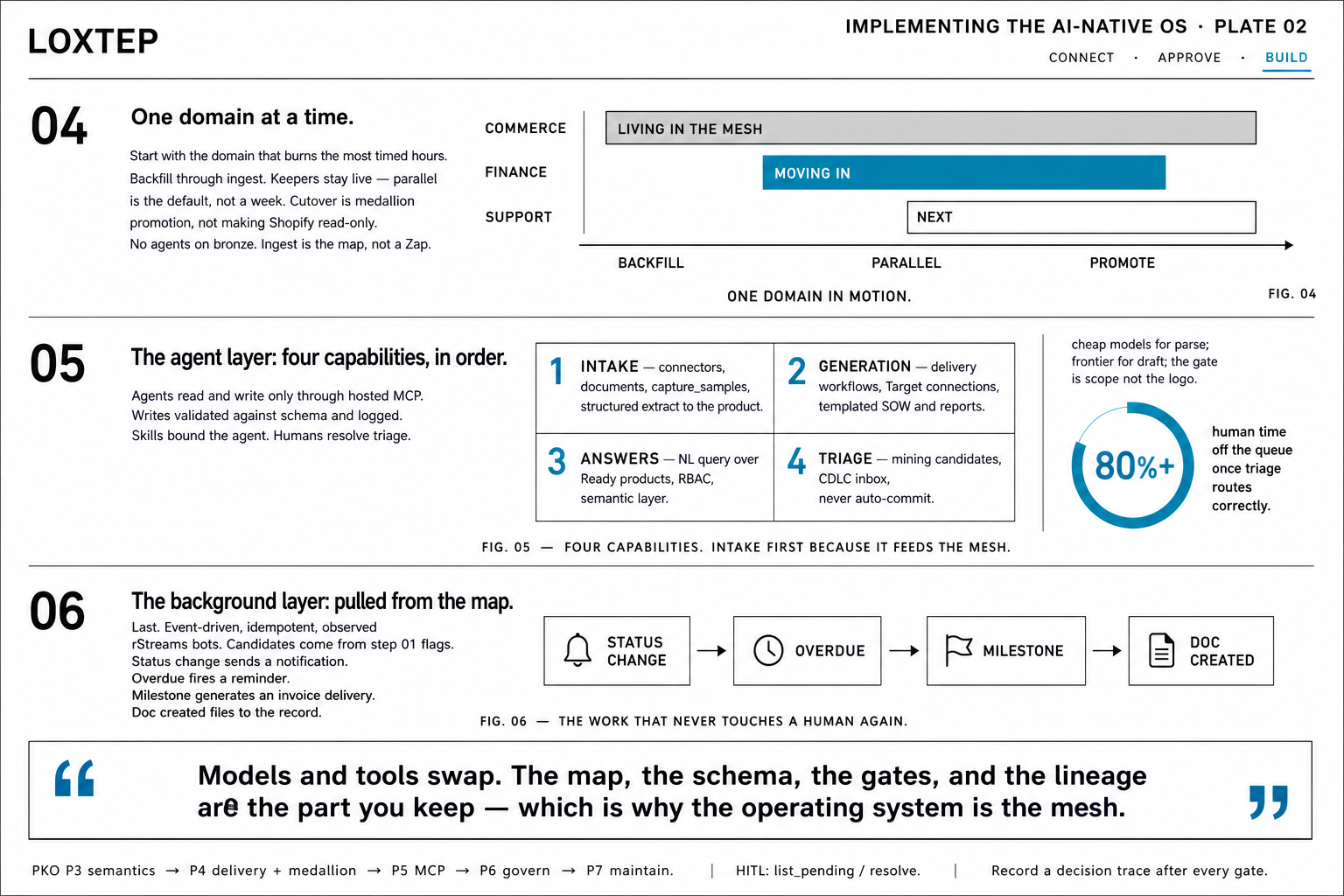
Move the domain that burns the most hours first — often commerce, then finance, then support. Backfill through ingest. Keepers stay live; parallel is the default, not a ceremonial week. Cutover is readiness promotion, not making Shopify read-only.
Studio views can still look like boards. The truth is the data product. Do not put agents on Raw products. Ingest is how you see the process. It is not permission to automate a process you have not fixed.
Use
When a domain is living in the mesh, agents and background jobs have something real to stand on.
Four capabilities, in that order
Agents use the hosted MCP server, scoped by skills and RBAC. Build them in this order because each one feeds the next:
- Intake — connectors and documents into structured records. This is first because it fills the products everyone else reads.
- Generation — delivery workflows and Target connections: proposals, reports, client updates from live context instead of an afternoon of hunting.
- Answers — natural-language query over Ready products, with field-level governance. “Which invoices are overdue” should not mean twenty minutes in three UIs.
- Triage — classify inbound work onto a human queue. The review inbox is the product. Nothing auto-commits.
Use cheaper models for parse-and-route. Use stronger models for draft-and-reason. The gate is skill scope and published context, not which vendor logo sits on intake.
Add the hosted server to the agent you already use:
{ "mcpServers": { "loxtep": { "url": "https://mcp.loxtep.io/ai/mcp/stream" } } }
Background jobs last, pulled from the map
The last layer is event-driven, idempotent, observed workflows — status change notifies, overdue reminds, milestone delivers an invoice, a new document files to the record. Those candidates came from the flags on the first mapped ingest. This is the work that never touches a human again, after the process is true.
What you keep when models change
Models and tools will swap. The map, the schema, the gates, and the lineage are the part you keep. That is why the operating system is the mesh — connectors, data products, published context, and observed workflows — and why you do not wait for a new ERP or a custom internal app to get started.
Public areas are Connect → Products ↔ Meaning → Use. Inbox handles approvals and Observe supplies runtime evidence; neither is another journey stage. Organization holds people, policy, governance, billing, and configuration. Under the hood the same journey is the procedure chain from session bootstrap through connect, samples, ingest, semantics, delivery, readiness, MCP access, governance, and ongoing maintenance. For the hands-on path after this mental model, start at Connecting your Data.